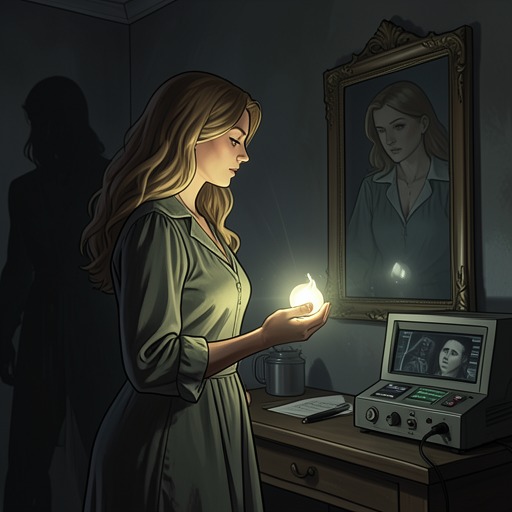
Faery Search Ritual Eligibility and Cost Rule
A Werewolf Thing: A Rejected Mate Werewolf RomanceThe Faery Search Ritual Eligibility and Cost Rule governs a specialized Faery rite used to find a missing member of the same kind. Its decisive significance is that the ritual is not an unrestricted magical solution: it depends on Faery identity, draws directly on the practitioner’s energy and power, and can cause death if prolonged. The rule therefore makes the search for Saphira Richards a choice between helplessness and self-endangerment rather than a consequence-free act of rescue.
Definition and Eligibility
The rule is introduced through Trevor’s explanation that Faeries can perform a ritual when searching for one of their own. The wording establishes a communal and biological limit: the rite is designed for locating a Faery, not for finding anyone regardless of lineage. Trevor’s eligibility is connected to his identity as one of the twins born half werewolf and half witch, while his family history also links him to the Faery succession expected of him and Saphira Richards. His grandfather had summoned both twins to perform the Faery ritual because they were supposed to lead their people after reaching eighteen, despite the disruption caused by their mother’s departure.
The rule is restrictive in practice. Trevor states that only full Faeries had ever performed the search ritual. This qualification makes his proposed use of it exceptional and uncertain: he possesses a connection to Saphira Richards, but the established precedent does not clearly include someone of his mixed heritage. The ritual’s availability is therefore separated from simple magical ability; lineage and degree of Faery identity determine whether the rite can properly be attempted.
Twin Connection and Intended Use
Trevor’s decision arises from Saphira Richards’s disappearance. When others do not know where she is, he explains that she is his twin and that their connection extends beyond blood. That bond supplies the emotional and supernatural basis for the search. It also distinguishes the ritual from an ordinary tracking method: Trevor is not merely following a trail but trying to use a kinship that reaches beyond physical proximity.
The rule is closely tied to the twins’ life-and-death connection. Trevor explains that if one of them dies, the other dies as well. This condition raises the stakes of the search in two directions. Saphira Richards’s absence threatens Trevor because her survival is directly tied to his own, while Trevor’s attempt to locate her exposes him to the separate dangers built into the ritual itself. The same family bond that makes the search possible also makes delay and failure especially consequential.
Energy Cost and Risk of Death
The ritual consumes the practitioner’s energy and power. Trevor emphasizes that it drains those resources rather than producing knowledge without sacrifice. Its danger increases with duration: if the ritual continues for too long, it could cause death. The rule consequently contains an internal limit, requiring the searcher to balance the need for information against the physical and magical capacity to continue.
This cost prevents the ritual from resolving the crisis automatically. Trevor has not already used it because the rite has traditionally been performed only by full Faeries, and his mixed status makes the attempt hazardous as well as unprecedented. His willingness to proceed transforms the search into an act of deliberate self-sacrifice. The narrative’s value conflict is therefore clear: locating Saphira Richards may preserve a twin and recover a missing family member, but the method may kill the person who performs it.
Narrative and Thematic Significance
The rule gives Faery power a defined boundary. Other supernatural events in the story include the full moon ritual proposed by Ashton Smith, the Faery ritual demanded by Trevor’s grandfather, the Banshees’ lethal screams, and the prophecy of a future vampire-werewolf war. Against that wider supernatural background, the search ritual stands out because its limitation is stated explicitly: eligibility is narrow, and use has a measurable bodily price.
It also turns identity into a practical burden. Trevor and Saphira Richards are not simply individuals with unusual abilities; their mixed heritage places them between categories while their twin bond binds them together. Their inheritance opens access to a Faery tradition, yet the restriction to full Faeries places that access in doubt. The rule thus makes bloodline, species, family duty, and personal loyalty converge in a single decision.
Most importantly, the ritual frames rescue as expenditure. Trevor must risk his energy, his power, and potentially his life to reach Saphira Richards. The rule preserves the seriousness of the disappearance by refusing an effortless magical remedy: the search can be attempted only through exceptional eligibility and at a cost that may be fatal.